
Newark Previous Residents by Era
Begin with the source that covers the year in question, then move across records rather than asking one index to answer every question. The county land chain is durable, but it identifies recorded parties. A directory can add a listed adult at an address. A census can show relationships in an enumerated household. Vital, probate, obituary, and history collections can explain a move, death, inheritance, or place name. The table keeps those time spans and evidence types distinct.
| Source | Years It Covers | Where Held | What It Shows |
|---|---|---|---|
| Alameda official land records | 1853-present; microfilm 1853-1968, electronic 1969-present | Alameda County Clerk-Recorder | Recorded owners, parties, instruments, legal descriptions |
| Current assessment and GIS | Current and selected assessment history | Alameda Assessor and County GIS | APN continuity, situs, parcel shape, structure clues |
| Regional city and reverse directories | Exact Newark-bearing run not published | Alameda County Library, Oakland History Center, catalogs and established digital collections | Listed adults, occupations, street addresses, reverse entries |
| Federal census | 1790-1950 public; 1960 follows the 72-year closure | National Archives and library databases | Names, ages, relationships, birthplace, occupation, later address context |
| Alameda vital records | Coverage and eligibility vary by record and year | County Clerk-Recorder and California Department of Public Health | Birth, death, marriage, and qualifying divorce-record evidence |
| Newark history collection | Late nineteenth century onward, item dependent | City history collection and local repositories | Named places, people, buildings, industry, and community context |
| Sanborn fire-insurance maps | Newark-specific sheet years not confirmed | Library of Congress and California library catalogs | Building footprints, uses, and street continuity where covered |
The most important research gap is explicit: the official library website does not expose a complete shelf list of Newark-bearing publishers, years, or reverse-directory runs. Do not fill that gap with invented volume names. Ask a librarian or local-history curator to verify the catalog item before treating a year as a confirmed Newark source.
Newark APN for Previous Residents
Normalize the present street address and find its Alameda parcel number before searching for past residents. The APN is the stable thread that can link the current situs to an assessment card, a GIS polygon, a permit, and a recorded instrument. Save the exact situs spelling, subdivision or lot information, and map position. A mailing address may be different from the land's physical location, so keep both fields separate whenever the record exposes them.
Open the assessor result, record the APN, use and type, land and improvement values, tax-rate area, building facts, assessment events, and any visible transfer reference. Then select the same polygon in the Alameda County parcel viewer. Pan to adjoining lots only after the target is fixed. Trusts, limited liability companies, and family transfers can hide a natural person's name, so a parcel clue is a starting key rather than a conclusion about who lived there.
- Keep the current address, alternate spelling, unit, ZIP, and APN together.
- Save the parcel card and the map position before searching older material.
- Use the transfer reference or known acquisition to find the present deed.
- Carry the legal description into every earlier search.
- Compare the chain with directory, census, permit, and obituary evidence.
This APN-first habit is useful when a Newark street number has been altered, a road was described under Washington Township, or a later subdivision changed the address context. If the research goal becomes the current street rather than the backward chain, the Newark street directory keeps the parcel and block workflow separate.
Trace Newark's Deed Chain Back
Use the present acquisition instrument as the first rung of the chain of title. In plain terms, the chain of title is the sequence of recorded transfers that connects one parcel to earlier parties. A grantor is the party giving or transferring an interest. A grantee is the party receiving it. Search the present grantee, read the instrument, then search that deed's grantor as an earlier grantee. Repeat until the record, legal description, or research access ends.
- Locate the present acquisition by APN, transfer reference, party name, or instrument number.
- Copy every grantor, grantee, recording date, document type, instrument number, and legal description.
- Search the seller as a prior buyer and test spelling variants in the party index.
- Confirm the same subdivision, lot, APN, or legal description before joining two deeds.
- At the 1969 boundary, move from the computer index to older books and microfilm.
- Grantor
- The named party who transfers or grants an interest in the recorded instrument.
- Grantee
- The named party who receives the interest described in the instrument.
- Chain of title
- The linked sequence of recorded transfers for one parcel.
- Legal description
- The lot, subdivision, map, or boundary language that identifies land beyond a postal street label.
The Alameda official-record copy-order form shows the known-instrument route for an image request. It requires the instrument number and adds a $2 convenience fee for card payment. The index is a locator, not a title report, and an image may contain redactions or protected material.
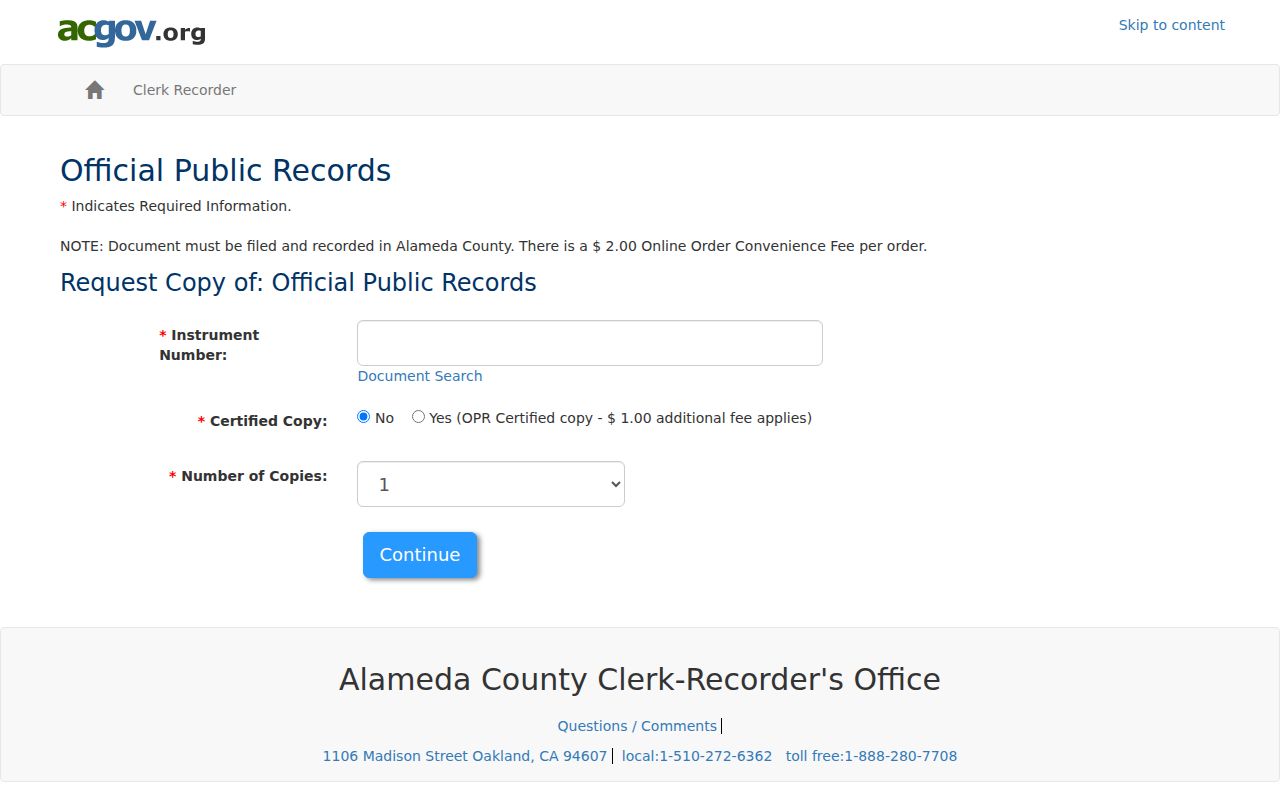
The copy-order image belongs beside the deed-chain method because a precise instrument number is what turns a party-index result into a document request. For an older link, note the reel, image, book, and page reference instead of forcing it into a modern search box.
Newark Records Before 1969
Alameda County official records reach back to 1853, the county's organization year, but the computer index starts in 1969. A search for previous residents therefore changes method at 1968. Use the online index for 1969-present. For 1853-1968, use the Clerk-Recorder public research area, alphabetical grantor and grantee books, microfilm, and deed books at 1106 Madison Street. The cutoff marks digitization and indexing, not a known loss of older records.
Prepare the handoff before an in-person visit. Bring the latest instrument, all party spellings, the APN, the subdivision or lot, the recording date, and any book, page, reel, or image clue. Search the seller as a buyer in the older alphabetic index. A street name may be shortened or linked to a regional place name, while the legal description can keep the parcel aligned across years.
Alameda County Official Public Records information explains the 1853 and 1969 access split, historical copy routes, and the distinction between index data and the document image. Counter staff can explain how to order or inspect a record, but the researcher must still test that the land description follows the same address backward.
The Alameda Official Public Records index page is the source shown in the Newark previous residents image for this pre-1969 handoff.
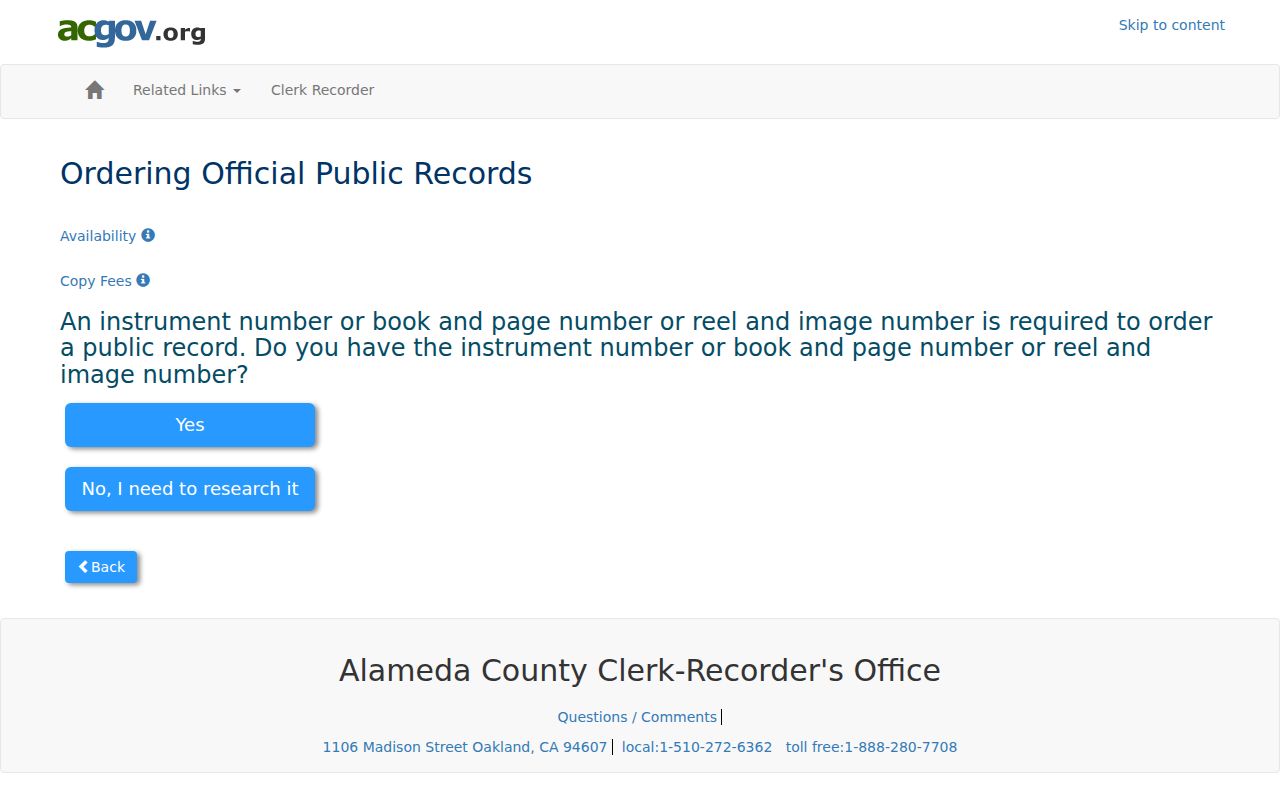
The index notice makes the 1969 computer boundary visible. Older names require the office's microfilm and alphabetical books, while newer names can begin in the electronic party index.
The 1969 switch is one of the key quirks in a Newark previous residents search. Recent transfers may take minutes to locate, while a nineteenth-century owner can require Oakland travel, microfilm work, and a second source. Treat the extra work as a documented access step, not as a reason to invent a missing household.
Newark Directory Trail for Past Residents
Newark's historical directory trail is regional because the community was a small railroad and industrial town before incorporation in 1955. Search not only Newark, but also Alameda County, Oakland-Alameda, Hayward, Fremont, Centerville, Niles, Irvington, Mission San Jose, Washington Township, and Union City. A catalog may describe the place served rather than print Newark in the title.
Alameda County Library offers branch access to Ancestry Library Edition, HeritageQuest, Newspapers.com Library Edition, HeritageHub obituary and death notices, NewspaperARCHIVE, Hispanic Life in America, and My China Roots. The Newark branch is the closest public library route. The Oakland History Center is a countywide fallback with Oakland directories from 1869-1943, Alameda County voter registers from 1867-1944, obituaries from 1951-1993, and related certificates. Coverage must be checked before assuming a Newark entry is present.
The Washington Township Museum of Local History at 190 Anza Street in Fremont holds noncirculating books, yearbooks, newspapers, original documents, clipping files, maps, blueprints, selected assessor books from 1893-1902, California Nursery ledgers, photographs, and recordings. Research is available during public hours or by appointment at 510-623-7907. A curator can help connect a past Newark address to a regional collection without treating a local photograph as a resident roll.
The Newark historical city directory collection guide keeps the directory shelf and its catalog gaps together. On the previous residents trail, use a verified address entry only to bridge between deed dates, census years, and a later personal record.
Newark Census Clues for Previous Residents
Directories fill the years between federal census schedules. Start with a known address and name, read the alphabetical entry, then check the reverse section if the volume has one. Record spouse notation, occupation, employer, street number, and any mark such as `h`, `r`, `bds`, or `wid`. Next compare the 1940 or 1950 census, which can show ages, relationships, birthplace, occupation, and the full enumerated household. A directory disappearance may mean a move, death, nonparticipation, renumbering, or a missing volume.
- Find the nearest confirmed directory entry and copy its street wording.
- Search adjacent directory years for the same name, address, and occupation.
- Use the reverse section to test the address when the name is uncertain.
- Pair the span with the closest public federal census, through 1950 under the release rule.
- Check vital, probate, obituary, or cemetery evidence before calling a person a past resident.
Alameda County birth, death, and marriage records access explains the county route for copies and marriage services. The vital record image shows the official application channel that sits beside a directory or census clue, not a shortcut around eligibility.
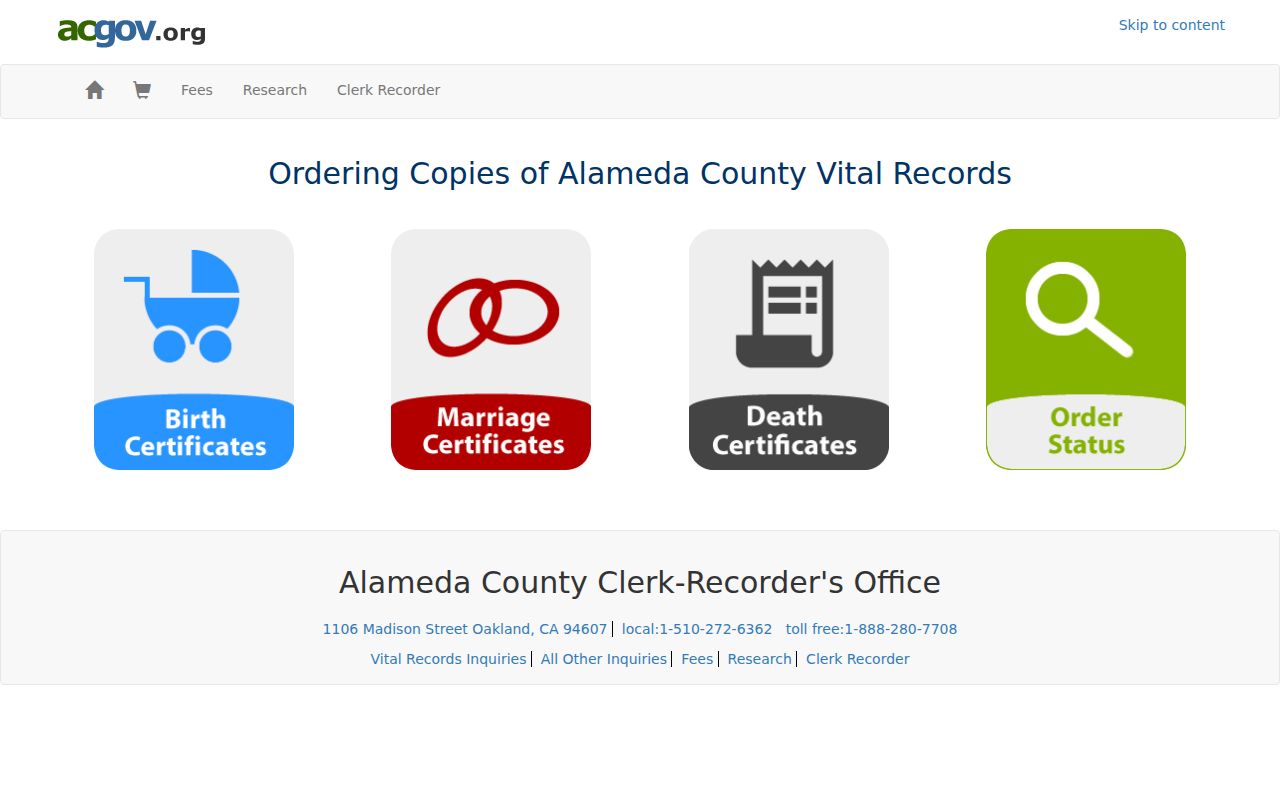
California uses confidential and informational-copy channels rather than one simple closed-year rule. Authorized certified copies require an eligible requester and sworn statement under Health and Safety Code sections 103526 and 103526.5. Informational copies are marked and cannot establish identity. The current CDPH vital-record fee schedule should be checked before ordering. Adoption files are sealed under Family Code section 9200, and confidential marriages have a separate rule.
The California Department of Public Health vital-records route supplies statewide application guidance through mail and electronic vendor channels. Alameda County handles county copies, while Alameda Superior Court handles divorce decrees; CDPH supplies a certificate of record for qualifying divorce years.
The National Archives census research page is the direct federal access route for released schedules and the 72-year framework. The census image connects a named person to an enumerated household, while the deed and directory layers answer different questions.
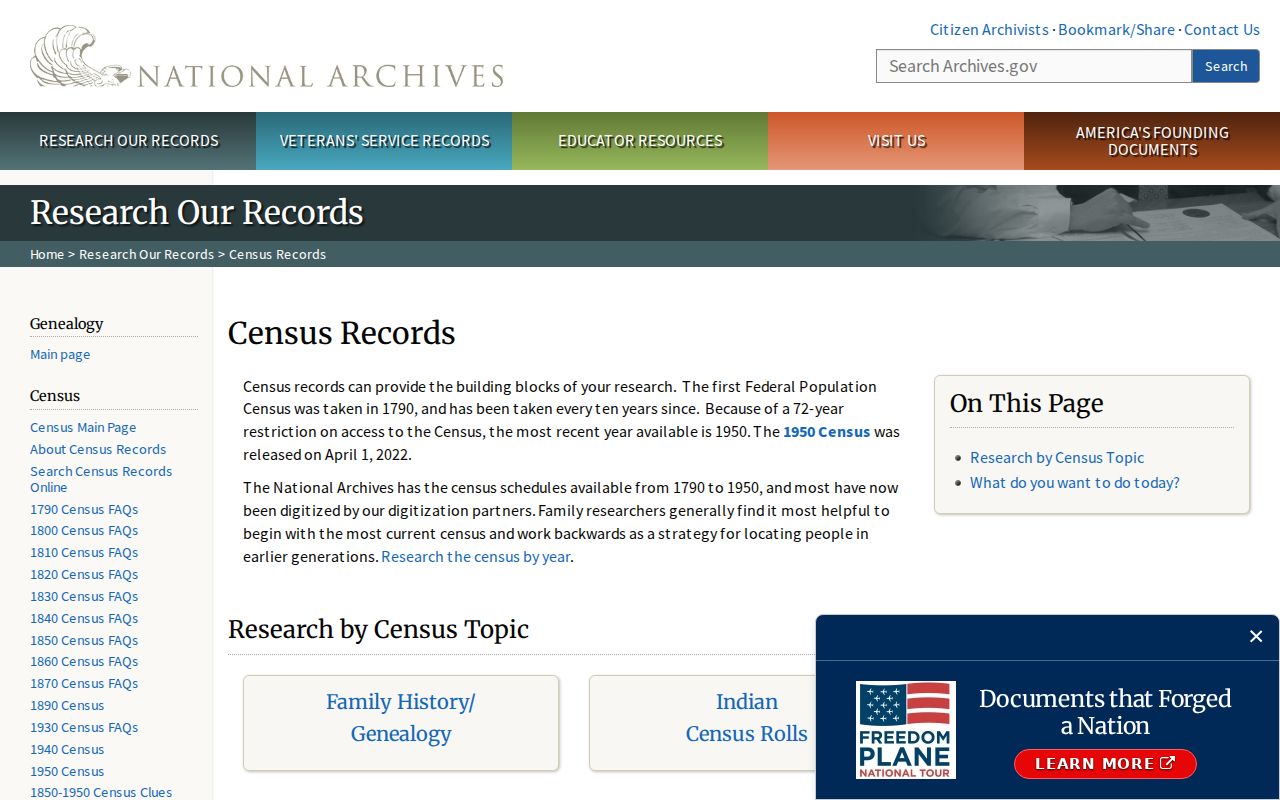
Use library databases, the NARA route, and a local archive as separate channels. A paywall, missing scan, or closed record should lead to the next custodian, not a claim that the household never existed.
Newark Address Gaps in Permit Records
Newark eTRAKiT can date building work at an address, but it does not date every occupant. Public general searches cover Building, Planning, and Public Works permit modules. Search by site address or APN and note permit type, issue or final status, date range, applicant, and contractor when exposed. Registration is required for applications, payments, and inspection scheduling. The public guide does not promise a complete historic permit run, so legacy coverage remains a research limit.
When an online permit search is thin, request an existing file through Newark's Public Records Act channels. The city accepts verbal, email, phone, and in-person requests. A determination is normally due within ten calendar days, with up to fourteen additional calendar days for unusual circumstances. The city does not have to create a record, answer a research question as a new record, or release material that is exempt or redacted. Ask for the address, APN, record type, and date span.
Library of Congress Sanborn maps can add building footprints and uses, but no confirmed Newark-specific sheet years were located in the official online catalog. California library catalogs are fallback channels. A map image, permit, or photograph is strongest when its street and lot are checked against the deed's legal description.
Newark's 1878 Old Town grid, later subdivisions, and the shift toward the railroad curve make continuity hard. No official Newark-wide renumbering table was located. Preserve every old number, street spelling, APN, recorded map, lot, block, and legal description. If the link remains uncertain, ask the City Clerk or Engineering for an existing street-name resolution or address-assignment record.
Newark Railroad Townsite Records
Newark's place history explains why previous residents can appear under several geographic labels. Mayhew's Landing existed by 1853, followed by reclamation, ranch subdivision, the Green Point Dairy townsite plans, and Robertson's choice of the Newark name. Railroad work and the later South Pacific Coast line moved the practical town center toward the tracks near Thornton, Sycamore, and Carter. A nineteenth-century person may therefore be indexed under Alameda County, Washington Township, or a regional railroad community rather than an incorporated Newark label.
The historic record also changes when city government arrives. Newark incorporated on September 22, 1955. Its first council met at midnight at Muller School, and streets stayed county streets until July 1, 1956 because the new city lacked gas-tax revenue. That handoff helps explain why an early road or administrative record may not sit with the later municipal custodian. Use the city history collection, recorded maps, county directories, and deeds together.
The railroad context is practical, not just color. Directory entries tied to railroad, salt, stove, foundry, dairy, nursery, agriculture, technology, or manufacturing work can help distinguish same-name people when an address and occupation align. The occupation is an identity clue, not proof of a home or a complete household. Keep it beside the deed, census, or obituary rather than using it alone.
Newark Probate Clues for Past Residents
Probate and obituary research adds a human layer to previous residents. When a former owner died, an Alameda probate case may name a representative, heir, petition, notice, or property interest. A local obituary can connect the person to a spouse, parent, club, church, cemetery, or former address. These clues help family historians move from a recorded owner to the people who handled an estate, but a notice still needs a date and place check.
Search Tri-City newspapers and funeral-home archives through library resources, then compare a death index, probate entry, cemetery record, and deed transfer. The Alameda eCourt civil and probate portal has confidentiality limits, and not every heading makes every document public. A clerk can explain a case-number or copy request, while the record itself must be read for the scope of what is open.
Obituary-derived family names can also attract scams. An unexpected request that uses a Newark relative's name should be verified through a known phone number and an official custodian. A prior resident's identity is a family-history clue, not permission to contact unrelated people or publish private details.
Use probate, obituary, and deed events as endpoints in a chain. If all three point to the same person, date, and parcel, confidence rises. If one conflicts, label the conflict and return to the legal description, census household, or clerk-held image.
Newark Previous Residents in Context
Previous residents are not the same as previous owners. A deed records a transfer of an interest. An assessment card describes a parcel. A directory lists the people a publisher chose to include. A census enumerates a household at a point in time. A permit identifies a project. The useful result is a layered account that says exactly which source supports each name and which names remain unverified.
For a long trail, keep a year-by-year ledger with columns for address wording, APN or legal lot, source, named person, role, event date, and confidence. Mark a former owner, listed householder, boarder, spouse, heir, or business contact as different roles. Do not turn a return address, a mailing address, a license address, or a neighbor's statement into a residence claim without a source that supports it.
The Alameda County Clerk-Recorder services page is the official county entry for recorded documents, vital records, marriage services, and related clerk routes. It helps separate a copy request from a history question and sends a researcher to the right custodian.
The Clerk-Recorder image belongs at the end of the workflow because the custodian, not a compiled directory, decides what copy or index access is available. The trail is complete only when the evidence and its limits are both recorded.
Lawful use. Previous resident research in Newark is for personal, lawful family history, property history, and reconnection. Do not use a past address or a former resident's name to stalk, harass, intimidate, or harm anyone, and do not try to defeat a protected address.